
By Colleen Russo Johnson, Makeda Mays Green and Maya Lennon
While the media industry has made tremendous progress in recent years to ensure that children of various backgrounds see themselves represented on screen, one area that is often overlooked is wealth.
The characters and settings kids see on TV don’t just entertain them—they shape how they think about class, money and success. These portrayals influence how children perceive themselves, how they compare their own lives to others, and even how they imagine their futures.
In a recent research study by Nickelodeon involving more than 1,100 parents and 600 kids ages six to 11, we set out to explore how financial realities show up on screen—and how they do (or don’t) reflect kids’ own lived experiences. The results are clear: Kids notice wealth. A house isn’t just a TV show back-drop—it’s a message.
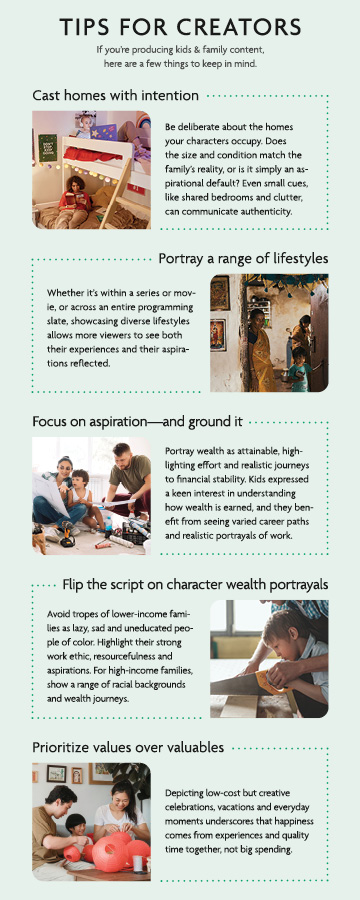
Homes, as it turns out, are one of the very first cues kids use to understand wealth. When we asked children which homes from TV shows and movies felt like theirs, many struggled to name even one. The vast majority of on-screen homes children thought of were big, beautiful…and largely unattainable. Meanwhile, only 5% of kids said their house is bigger than the ones they usually see on TV.
For kids who live in smaller or single-story homes, something as simple as an indoor staircase became a symbol of wealth. They also noticed the home’s condition: Is it clean and new-looking? Or cluttered and showing its age? A seven-year-old told us, “I don’t know a show [home] that looks like mine. Our house is really old and falling apart, and all the paint is peeling.”
These visual cues extended beyond the home as well. Kids in our study pointed to cars, vacations, pools, jobs and birthday parties as other signals of a family’s financial situation. And they’re also tuning into how characters are portrayed. Kids perceive rich characters as spoiled, popular, fancy, white and automatically happy. Meanwhile, they perceive poorer characters as sad, lonely and kind, often with single parents and disproportionately Black.
Whether it’s intentional or not, these narrow portrayals can perpetuate harmful stereotypes about what it means to be in both a lower and higher income bracket.
UNRELATABLE WEALTH
This limited representation isn’t just a visibility problem—it impacts how kids feel. Some kids expressed sadness, envy or embarrassment when watching characters live in big, beautiful houses. One 11-year-old said, “Our house is nice; it’s just that we don’t have a lot of what we see on TV that I would love to have, like a pool and a fenced-in large yard.”
Meanwhile, a 10-year-old girl admitted, “I feel jealous that those kids have more things like clothing and bigger houses. I feel embarrassed that I don’t have that many things.”
Parents also noted the impact. “A lot of the shows my daughter watches portray things I can’t afford,” one mom explained. “She asks for what she sees on TV, and it makes me feel like I’m not good enough to give her what she wants.”
ASPIRATIONAL WEALTH
But wealth on screen isn’t inherently problematic. In fact, depicting financial prosperity in ways that feel realistic and attainable can have a positive impact on kids. It can spark motivation and ambition. For some kids, these portrayals can provide a critical roadmap that they don’t see in their daily lives.
“It makes me want to know more about how the family became successful so I can grow up and be successful, too,” said an 11-year-old. And a nine-year-old added, “It makes me want to go to college, get a great job, and buy a bigger house.”
From a parent’s POV, one mom noted: “I would like my child to see more of the mansions to inspire her to dream big and strive for greater things. I want her to grow up knowing that beautiful things exist, and every single one of them is within reach.”
But when kids never see the effort it takes to achieve those lifestyles, or when the characters seem to be magically wealthy for no reason, it can feel disheartening.
AVERAGE WEALTH
Ultimately, families want more portrayals that reflect average, everyday realities. A dinged-up used car. Birthdays in the backyard with homemade decorations. Parents working and budgeting. Featuring relatable wealth fosters deeper connections with a show’s characters and content. Seeing homes and lives that feel familiar helps kids feel seen and understood. For the majority of Americans, this means showing more modest economic lifestyles.
However, what matters equally is how lower-to-average-income families are shown. For lower-income portrayals, parents want to see families pursuing dreams and aspirations despite economic hardships, as well as working hard and being happy, resilient and resourceful while budgeting/saving (including not wasting food).
“I wish a more modest family could be shown in a happier light for my small child to relate to,” said one mom. “I feel that families in trailer parks are shown as unhappy, or at the very least discontented, and I wish that didn’t exist so that my child doesn’t grow to feel ashamed of our life.”
Parents want content to challenge wealth stereotypes and emphasize that core values and experiences—like kindness, hard work, happiness and quality family time—are attainable by every family and do not depend on money.
THE BOTTOM LINE
Kids are observant, empathetic and deeply influenced by what they see. They’re building their understanding of the world—and their place in it—in part through media. When we only show one version of success, we limit their imaginations. But when we show families who live in all kinds of homes, work all kinds of jobs, and find joy in all kinds of ways, we expand what’s possible for them. The goal isn’t to eliminate aspiration.
It’s to make sure that every kid sees a path forward and can imagine themselves on it.
Dr. Colleen Russo Johnson is VP of digital and cultural consumer insights at Nickelodeon. She delivers research-driven insights that shape engaging and meaningful media and technology experiences for kids and families across Paramount. Makeda Mays Green is SVP of digital and cultural consumer insights at Nickelodeon. In this role, she evaluates the most effective ways to reach target audiences through innovative research methodologies across Nickelodeon’s/Paramount’s platforms. Dr. Maya Lennon is manager of digital and cultural consumer insights at Nickelodeon. She specializes in delivering qualitative and quantitative insights that drive impact and engagement throughout interactive ecosystems.
This story originally appeared in Kidscreen‘s Q4 2025 magazine issue.



















 Newsletter