
Operating in a cultural heritage, arts & tourism market that’s crowded with options, the world’s 100,000-plus museums are having to rethink how they go about connecting with kids—and licensing may be the key to staying relevant.
The UK is currently a hotbed for these location-based experience collaborations, according to data presented at last year’s Brand Licensing Europe by Licensing International and Circana. The region saw a whopping 682.9% surge in licensed service earnings in 2024, including museums, theme parks, hotels and restaurants. Nonprofit licensing was also the UK’s fastest-growing category that year, with a 16.8% uptick in sales from museums signing new partnerships with a mix of brands for both kids and adults.
“Collaborating with kids entertainment brands is a fantastic way for us to broaden the reach of the museum and its licensing program into new audiences and retailers,” says Louisa Skevington, licensing manager for the Natural History Museum. “It’s a way of grabbing a kid’s attention with their favorite characters, and then engaging with them in new ways through our historical topics and expertise.”
When Skevington joined the London museum in 2024, her team was in the midst of a major licensing push, setting up partnerships with the Roald Dahl Story Company, Hasbro for Peppa Pig and, most recently, The Pokémon Company International. She explains that her museum chose to dive deeper into licensing in order to add more consumer product touchpoints through which guests can physically interact with the museum at home.
“Brands such as Roald Dahl and Peppa Pig have strong aesthetic styles and instantly recognizable characters, which makes them exciting to work with,” says Skevington. “However, as the Natural History Museum is a less tangible brand in this way, we have to be creative in how we introduce our brand alongside them, such as through fun facts and the knowledge behind the design/development process.”
These agreements resulted in the museum also teaming up with leading regional retailers Marks & Spencer (for Roald Dahl) and Tesco (for Peppa Pig) to manufacture and distribute three waves of co-branded kids apparel designed to extend the reach of each collab beyond the museum’s e-commerce site and physical gift shop.
While neither of these partnerships evolved into a full-on immersive exhibit, Skevington developed and then promoted an Extraordinary Explorers nature theme for the Roald Dahl launch and a wider focus on dinosaurs, animals and outer space inspired by Peppa’s curious personality.
To tie together Peppa Pig and the Jurassic theme, the team set up standees of Peppa and Georgie wearing dinosaur costumes in the activity playroom for preschoolers, while the apparel collection depicted the show’s characters adventuring with animals and other prehistoric creatures.
Living in a Pokémon world
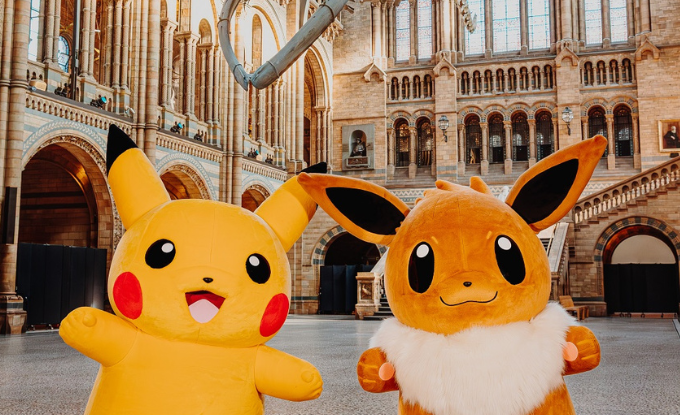
Taking a different approach, the Pokémon brand launched a first-ever UK pop-up shop at the Natural History Museum in January, offering a new range of exclusive merchandise spanning plush, apparel, trading cards and on-site meet-and-greet opportunities with Pikachu and Eevee.
This marks the second museum partnership for The Pokémon Company International’s EMEA team—the first was a four-month-long exhibit at the Van Gogh Museum in 2023 to celebrate the nonprofit’s 50th anniversary. In addition to a range of exclusive merch, the partners also worked together to create six Pokémon paintings inspired by Vincent van Gogh’s famous works and exhibit them for a limited time.
Museums are a growing category of interest for TPCI, which is looking for more culturally relevant destinations through which fans can immerse themselves in the brand, says EMEA licensing director Mathieu Galante. The Pokémon brand has also developed a massive multi-generational audience of kids and adults, which makes it a prime candidate for enriching the museum experience and making it a must-visit destination for the fandom’s legion of domestic and international visitors.
For Galante, the ideal museum partners are those that can deliver experiences reflecting Pokémon’s core values of science, adventure and nature in one tight package.
“Both [the Natural History Museum and the Van Gogh Museum] offer exactly that,” says Galante. “Vincent van Gogh’s documented love of Japanese art and culture created a natural bridge between the two worlds. Equally, the Natural History Museum has a sense of wonder and a connection to the living world, which is at the heart of the Pokémon brand.”
In addition to this work in the EMEA region, TPCI is building museum programs in Japan and the US to similarly widen its reach in other core markets. Initiatives that are underway include a Pokémon x Kogei traveling exhibit showcasing more than 70 custom works by Japanese craftsmen; as well as The Pokémon Fossil Museum, which is slated to make its first international appearance at the Field Museum in Chicago this May.
An entry point for preschoolers
One prodco that’s eager to do more museum collabs is GO-N Productions, which got its first taste in 2024 when it partnered with the Musée d’Orsay in Paris on a Simon Super Rabbit activation. Co-founder Eric Garnet says the studio was inspired to pursue the opportunity after seeing a recent increase in partnerships between European museums and animated brands, including Pokémon, One Piece, Paddington Bear and Barbapapa. And the Simon franchise was an easy “oui” for the French art museum because it could serve as an entry point to bring families with preschoolers and young children through the door.
“Simon perfectly embodies the meeting point between popular culture and the museum world,” says Garnet. “Preschoolers are at an age where they learn, experiment, grow and absorb everything around them. Going to a museum is naturally part of that journey—even if, like many children, it may not be their first choice for a fun destination at the start.”
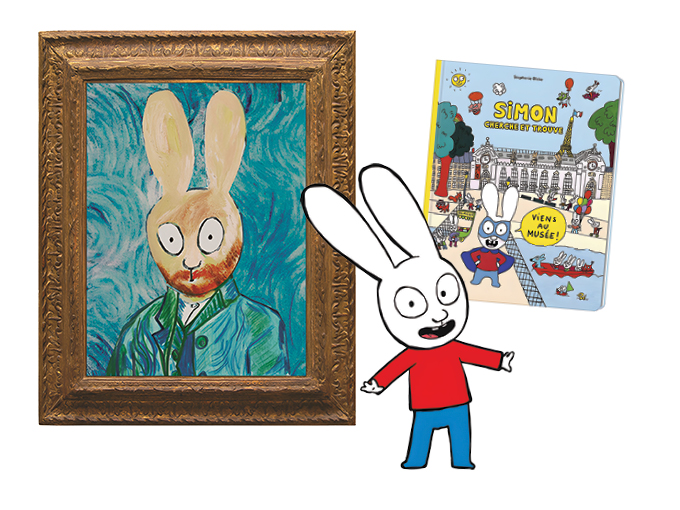
The Musée d’Orsay in Paris used GO-N Productions’ Simon Super Rabbit as a gateway brand to bring more kids to the museum. (courtesy of GO-N Productions)
Working with its French licensing agent Home Made Licensing, the Musée d’Orsay was originally looking to collaborate with a family-friendly IP that could support a co-published title about the museum, but this quickly expanded into an on-site activation and a much wider merch program after the non-profit’s head of publications recognized the value of an alliance with a growing preschool brand like Simon.
To kick the collaboration off , Simon’s original publisher L’école des Loisirs published a “hide-and-seek” book called Come to the Museum!, illustrated by the IP’s creator Stephanie Blake to show Simon and his friends jumping into iconic paintings found at the museum. At the same time, the Musée d’Orsay built a dedicated kids corner in its ballroom to offer activities including a reading area focused on various French animators, creative workshops with giant coloring posters, and a play and discovery space.
Meanwhile, Home Made Licensing leveraged its network of brand partners to develop a co-branded collection of consumer products ranging from staple SKUs like apparel, stationery and plush, to more experimental items such as yo-yos, magnifying glasses, kaleidoscopes and ink stamps.
“The collab proved quite challenging, mainly because the project required coordination between several teams and organizations,” explains Garnet. “With so many stakeholders involved, the decision-making process was sometimes slower than expected, but we were able to move the project forward at a steady pace with regular coordination meetings and clear task distribution.”
This program took nearly two years to come to fruition, but Garnet is proud of the outcome—most of the branded consumer products sold out, and the museum reported a significant uptick in museum visitors for the year. Based on these strong results, the Musée d’Orsay launched a second run of the Simon Super Rabbit activation late last year.
“Parents who attended the event have often told us that, thanks to Simon, they were finally able to take their children to a museum (when previously there would be little interest), and that their kids came out smiling,” says Garnet. “Building on our recent experience, we now plan to expand the concept to other museums across the European markets where Simon already has a strong foothold, such as Spain, Italy, the UK, Scandinavia and Germany.”
Image courtesy of Pokémon UK.
This story originally appeared in Kidscreen‘s Q1 2026 magazine issue.




















 Newsletter