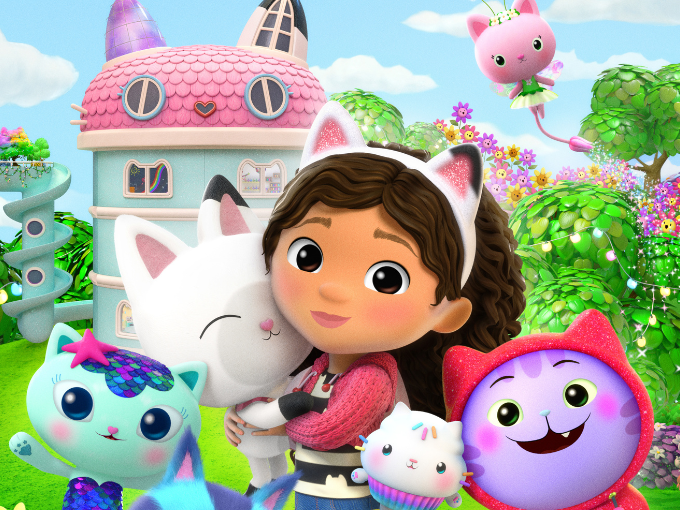
Gabby’s Dollhouse: An oral history

With its first movie out today, key execs from Universal and DreamWorks reveal how they built one of the world's biggest kids brands.
September 26, 2025

In just five short years, DreamWorks Animation has built a major preschool powerhouse with Gabby’s Dollhouse. What started as a 10-episode preschool series produced for Netflix has rapidly expanded to encompass consumer products, digital games and live experiences.

The IP has achieved several cat-tastic milestones, from selling more than four million dollhouses, to becoming the top kids series on Netflix worldwide, to racking up more than 3.5 billion lifetime views on YouTube. With its first feature film premiering today, Kidscreen is going into the dollhouse to explore the origins of the franchise with the execs who helped build its content and overarching strategy. 

“Let’s give it a go!”

Teri Weiss – EVP, TV development, DWA: I was really there at the ground floor in the early development phase in 2016. Jen Twomey and Traci Paige Johnson had an idea of wanting to do a mixed-media series with a dollhouse and cats. Early on, we thought about this concept as a room-to-room adventure. 

And then the other piece of that brainstorming phase was that Jen and Traci were fascinated with kids enjoying unboxing [videos], with there being a surprise coming out of a box. And so we said, what if we created a show where what you unboxed became the catalyst for a story?

Ryan Bradley – SVP, marketing, DWA: We started to see the trend that linear was declining and streaming was rising. The industry as a whole was experiencing a crisis of learning how to navigate these new waters. 

We had experimented with a couple of different paths with properties like Dinotrux and Trolls. But after having those experiences and learning from them, it was beneficial to come into planning Gabby’s to say, ‘We’ve got to work across all of these different channels in streaming, digital and linear from the outset and just take hold of it.’ 

Shannon Vacca – SVP, franchise strategy, Universal Products & Experiences: Gabby’s filled a major whitespace for us, where NBCUniversal leaders were looking for a way for us to take a stand in the preschool market and expand our portfolio with fresh IPs. 

The purr-fect elements

Weiss: Once the first season of Gabby’s launched on Netflix in 2021, I think what resonated with the audience most was this idea of wish fulfillment, and the live-action component. I don’t think a lot of studios were doing that element, where this was a girl who really broke the fourth wall and created that intimate relationship with the audience.

Bradley: The brand has been something that has connected to kids in a time where a lot of things aren’t certain in their lives and they’ve gone through major upheavals, such as [the COVID pandemic]. Are they in school or not? And what’s going on with their friends or parents? I think that this element has allowed Gabby’s to connect and build the deep relationship that it has with the audience.

Vacca: My role is to lead what we call IP evaluations. So we’re always looking at properties and studying them to see if they’re merchandiseable. I’ve always loved the dollhouse itself. Even now, it remains our core product in many ways because we built the entire play system around it. Once we had this anchor item, we thought about how to expand from there, whether it’s rooms or figures or even developing a cruise ship one year that can park right next to the house.

We had a ton of collaboration meetings where we would sit with the show’s creators and our product development team, and the strategy was, whatever is in the story, give us early visibility to upcoming hero moments or new characters and we would recreate that in new products with our toy partners at Spin Master and LEGO. 

Building the audience

Weiss: I think what I’m proud of most is that we had to really rewrite the playbook for Gabby’s. Out of the gate, we had to think about how we create a hit in today’s landscape, where kids are watching content completely differently than they were back in the linear days.

We had a comprehensive strategy as a company to have a complementary YouTube component with our Netflix episodes. This was key in the early days, where we figured out a way to have an always-on method for viewers to connect with the brand throughout all 12 months of the year. It felt like we really created a new model for how kids can engage with a property over the long term.

Bradley: I think what surprised me the most was that, despite Gabby’s being categorized as a preschool show, kids ages seven, eight and nine still wanted to engage with the brand. This presented a really awesome opportunity to look for additional ways to retain that audience, with something like our Roblox extension. Not only has the Gabby’s Dollhouse game been played more than 25.9 million times since its launch last year, but we also built it to function as a video content creation engine for our YouTube channel that the community could contribute to. It serves so many uses in our marketing channel, and it delivers something to the older end of our demographic, where they want to play together. 

Rolling with the punches

Bradley: Because SVOD and YouTube were our core, there were challenges convincing retailers, distribution partners and the outside world that this franchise can be successful. 

Many, especially international partners at the time, were asking things like, where’s the free-to-air strategy? There were always going to be opportunities to work in those traditional channels, but we had to make them pay attention to the streamers and educate them on why we saw so much value in SVOD platforms for our beginning strategies. 

Vacca: We had to prove our case to retailers that Gabby’s actual dollhouse wasn’t like any other one on the market, by showing how the products complemented and brought the series to life. 

A huge help in that field was showing those buyers the wide fanbase and sharing with them our multi-year content plan. It was all about giving them the confidence that we didn’t see Gabby’s as a flash in the pan or just a moment in time—we have long-term ambitions that are worth the risk and support.  

Weiss: I hate the word, but some predictors expected that the show would decay quickly. It’s this notion that a series or IP can start off strong, but just as quickly fall off and fade into the void. Thankfully, Gabby’s has defied all those algorithms and numbers, not only by sustaining its popularity, but by growing as well. The series has been going for five years now and has more than 100 episodes, and we’ve still got new people coming in and engaging with the entire library. 

Dolled up for the red carpet

Weiss: [Gabby’s Dollhouse: The Movie] has been one of the fastest feature films we’ve gotten off the ground, taking about 18 to 20 months to fully produce. When the opportunity came up, I was incredibly excited to see how we could push the IP creatively—not only in the animation space, but also adding even more live-action components, since the series takes place in Gabby’s room.

The film was built around the question of, what if we opened the door, went outside with her and had an adventure alongside her best friends and the Gabby Cats? We just could not be happier with the results. 

Bradley: It’s a delightful film, and I’m excited to see it bring more people into the brand. We have a huge roadmap ahead to support the launch, with more of the series on the way as well. The best is yet to come. 

About The Author

Search

Menu

Brand Menu