
For the past week, we’ve been commemorating Kidscreen‘s 30th anniversary by looking back over the past three decades at an industry shaped by constant change, creative risk and a stubborn belief that what we do matters deeply.
- We’ve asked 30 industry leaders what’s different since 1996, and what makes them hopeful for the future.
- Researcher Jane Gould talked about all the ways childhood has changed in that time—but what foundational messages kids always need, no matter the era.
- We’ve listed the top 10 game-changers in content, in tech and in consumer products.
- Kidscreen‘s founding publisher Ken Faier has discussed how to adapt to an ever-evolving industry.
And to close out our coverage, we’re looking back through at the last 30 years with a timeline of the biggest events that have altered the kids entertainment landscape forever. Some changes were obvious at the time. Others only made sense in hindsight. And through it all, kids kept moving faster than the adults trying to reach them. But one thing has remained true through it all: This industry never stands still for long.
Click here to read the online magazine version of this story.
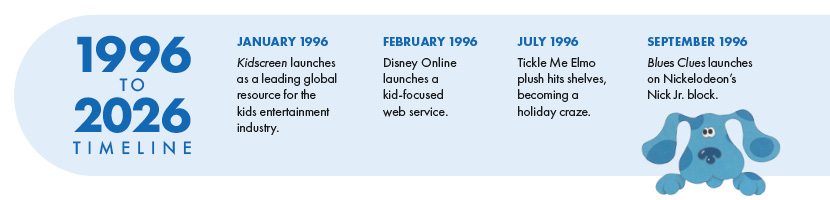
January 1996
Kidscreen launches as a leading global resource for the kids entertainment industry.
February 1996
Disney Online launches a kid-focused web service.
July 1996
Tickle Me Elmo plush hits shelves, becoming a holiday craze.
September 1996
Blues Clues launches on Nickelodeon’s Nick Jr. block.
October 1996
Discovery Kids Channel launches.
November 1996
DVDs enter the market, reshaping the entertainment landscape.
Bandai releases Tamagotchi in the US.
April 1998
Toon Disney launches.
Netflix kicks off its online DVD-by-mail service.
July 1998
Cartoon Network creates cartoonnetwork.com, introducing games, videos and early digital extensions of the channel.
November 1998
The Powerpuff Girls launches on Cartoon Network.
May 1999
SpongeBob SquarePants debuts as a sneak preview, before its official launch on Nickelodeon in July.
September 1999
PBS KIDS launches in the US.
March 2000
PS2 launches, eventually becoming the best-selling game console of all time.
The dot-com bubble bursts, leading to a recession, which eventually affects kids media markets worldwide.
August 2000
Dora the Explorer premieres on Nickelodeon.
April 2001
Yu‐Gi‐Oh! gets a US premiere.
May 2001
MGA Entertainment launches the Bratz toy line.
September 2001
9/11 happens. In the following months, younger viewers flock to kids channels to escape the news.
October 2001
The Walt Disney Company buys Fox Family Worldwide.
Degrassi: The Next Generation premieres on CBC. (It goes on to run until 2015.)
November 2001
WB’s Harry Potter and the Philosopher’s Stone premieres, casting a big-screen spell over the entire world.
Disney acquires The Baby Einstein Company.
May 2002
Columbia Pictures’ Spider-Man premieres, spawning a mega-film franchise.
November 2002
SARS breaks out, eventually cutting international toycos and retailers off from their Chinese manufacturers. (Some shift to manufacturing in other countries to cope.)
April 2003
The iTunes Store launches, creating a market for audiobooks and music content.
June 2003
Jim Henson’s kids buy back The Jim Henson Company from EM.TV & Merchandising.
May 2004
Peppa Pig premieres in the UK.
September 2005
Cable channel PBS Kids Sprout launches—later becoming Sprout, then Universal Kids, and staying on air until March 2025.
Aardman, which hasn’t produced a kids show since 1980, launches Planet Sketch, co-produced with Decode Entertainment.
February 2006
China bans TV shows and movies that blend animation with live-action actors.
March 2006
Nickelodeon signs its first- ever co-development deal in Japan with NHK, leading to a content exchange between the two channels.
September 2006
Roblox launches a platform for PCs.
November 2006
Nintendo Wii hits the market.
October 2008
Disney stages a franchise-first theatrical release for High School Musical 3.
March 2009
Mattel’s legendary doll brand Barbie celebrates her 50th birthday.
September 2009
Nickelodeon rebrands its dedicated Noggin preschool channel as Nick Jr.
December 2009
The first Angry Birds video game is released on mobile devices.
January 2010
This year marks the start of a new demographic cohort, Gen Alpha.
March 2010
Pixar’s Up becomes the second animated film to score an Oscar nomination for Best Picture, after Beauty and the Beast in 1992.
November 2010
The most expensive animated kids movie of all time—Tangled—hits theaters.
July 2011
The final Harry Potter movie breaks box-office records as the highest-grossing kidlit adaptation ever.
August 2011
Netflix launches its first kids section, signaling a new growth strategy. (Its first original children’s series, Turbo FAST, debuts in December 2013.)
November 2011
Sandbox video game Minecraft rolls out on personal computers.
March 2012
The Disney Junior programming block launches as a separate channel.
March 2013
Sesame Street becomes the first non-profit YouTube channel and the first kids media outlet in the US to hit a billion views.
July 2013
Penguin and Random House merge to form a kids publishing behemoth.
The FTC amends its Children’s Online Privacy Protection Act (COPPA) to include social networks and mobile apps.
August 2013
PAW Patrol debuts on TVOKids (Canada) and Nick Jr. (US)
October 2013
Toy giant Mattel launches in-house studio Playground Productions.
January 2014
Kidoodle.TV launches its OTT streaming service, joining happykids.tv in this growing landscape.
November 2014
For the first time in 11 years, Frozen dethrones Barbie as the top toy brand for girls in NRF’s annual holiday survey.
February 2015
YouTube Kids launches.
October 2015
Miraculous—Tales of Ladybug & Cat Noir premieres on Disney EMEA.
April 2016
NBCUniversal completes its acquisition of DreamWorks Animation for US$3.8 billion.
March 2017
Nintendo Switch hits the market.
September 2017
Toys “R” Us files for Chapter 11 bankruptcy.
February 2019
Mattel’s TV division gets a revamp and becomes Mattel Television.
September 2019
YouTube launches a US$100-million kids content fund (following an FTC settlement) and stops running ads around kids content.
November 2019
New streamer Disney+ launches.
Oasis Animation unionizes, kicking off unionization efforts at other North American studios.
December 2019
COVID-19 breaks out, leading to a huge boom in viewership as kids are stuck at home.
January 2020
Britain exits the EU, cutting off UK producers from European resources like Cartoon Forum.
February 2021
The NFT trend takes off, with kidcos wondering if it’s the next big thing. (It wasn’t.)
March 2021
Roblox goes public and tops US$45 billion on its first day.
August 2021
Sony acquires anime streamer Crunchyroll as the genre’s popularity soars.
April 2022
WarnerMedia and Discovery merge to form Warner Bros. Discovery.
September 2022
Generative AI goes mainstream as OpenAI releases DALL-E 2 to the public.
January 2023
Nickelodeon recognizes The Animation Guild in TAG’s largest production worker win.
YouTube shuts down its original kids content program.
February 2023
Sky Kids linear TV channel launches.
April 2023
The Super Mario Bros. Movie brings in more than US$1 billion, legitimizing video game adaptations.
Toy rivals Mattel and Hasbro join forces for the first time in co-branding deals.
May 2023
The Writers Guild of America goes on strike for five months, putting pipelines on hold.
July 2023
Barbie is the highest-grossing movie of the year, kicking off a scramble for toy-based films.
February 2024
Paramount shuts down Nickelodeon’s subscription-based Noggin app.
May 2024
9 Story and Brown Bag Films are the first in the industry to release a precedent-setting public AI policy.
December 2024
HBO declines to renew its output deal for Sesame Street, clearing the way for the classic show to make its way to Netflix.
January 2025
The first babies in Generation Beta are born.
February 2025
US President Donald Trump launches the first in a series of tariffs that will rock the consumer products industry.
June 2025
Netflix agrees to carry TF1’s content in France, kicking off a wave of streamer-broadcaster carriage deals in Europe.
July 2025
The US eliminates all funding for public media, signaling the end of the Corporation for Public Broadcasting.
Sky Kids stops commissioning content.
August 2025
Netflix releases KPop Demon Hunters—and it quickly becomes the streamer’s biggest movie ever.
September 2025
Iconic Canadian animation banner Nelvana halts production.
Telecom Rogers stops contributing to the Shaw Rocket Fund, effectively defunding a key kids content financing source in Canada.
December 2025
Australia’s ban on social media for all children under age 16 goes into effect.
And the journey continues…
This story originally appeared in Kidscreen‘s Q1 2026 magazine issue.


















 Newsletter