
Jonathan Haidt had some very polarizing things to say at Kidscreen Summit. In a keynote presentation called “Raising the Anxious Generation: What kids TV can do to help,” the social psychologist and bestselling author spoke about how smart phones, social media, short-form videos and a lack of real-world play are hurting kids.
Sharing data and research that has informed his writing (including his bestselling book The Anxious Generation), Haidt delivered a compelling argument that touch-screen devices and short-form content are “rewiring” kids’ brains, reducing their intelligence, and making them hungry for “quick dopamine triggers”. And this is important, given that 98% of two-year-olds watch screens (mostly short videos) for more than two hours a day.
Haidt got quite a warm reception from the Kidscreen Summit audience—warmer than he expected, he said during the Q&A that followed his presentation, considering that some of the content and platforms he came down the hardest on are where many creators are making their living these days.
Obviously this is going to be tricky territory to navigate, and Haidt was just looking to start a conversation rather than solve any of the complex issues involved. But there’s no doubt that there’s growing momentum at a government level and among parents to reconsider and restrict kids’ access to social media platforms. And if that movement turns its attention to short-form content (YouTube) and gaming platforms (Roblox), that would have huge implications for the industry.
Blue Ant Media’s A.J. Trauth (VP of development for kids, family, YA and animation) says a lot of what Haidt talks about, such as driving kids back to long-form programming and away from short clips that lack substance, actually makes good business sense.
If parents and policymakers follow some of his recommendations—like keeping young kids off social media and away from shorts (under a minute)—the result could be that kids, who are always hungry for entertainment, go hunting for longer-form content. And as parents and kids both de-prioritize watching shorts, investment in long-form content would follow, says Trauth.
“If we put ourselves in the shoes of kids today, and we want to help them have that moment of epiphany, of the value of story, and the transformative power of story, do we think that’s going to come in the form of a 15-second clip of brainrot?” he asks. “Or is it going to come from a slightly longer-form story with a beginning, middle and end and some sort of a takeaway?”
Trauth compares it to music, arguing that listeners won’t get the same enjoyment out of a song that’s 30 seconds long, compared to the usual two or three minutes. He also has some thoughts for the industry to consider about Roblox and vertical video that he’d been formulating well before hearing Haidt’s criticisms.
When it comes to Roblox, the platform isn’t perfect, but it has a lot of value as both a social experience and as a place where kids can have fun and express themselves.
And as for vertical video, Trauth urges the industry to think about it as a format that’s separate from the sort of short-form videos Haidt is railing against. Vertical microdramas are really just long-form series that are meant to be consumed in shorter bite-sized pieces. (He compares them to the choose-your-own-adventure books kids grew up with decades ago, where a larger narrative unfolds step by step).
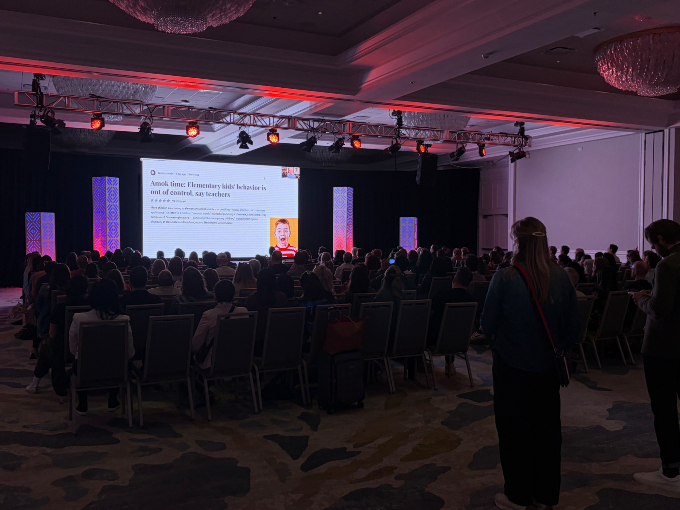
Haidt’s Kidscreen Summit keynote. He appeared virtually, and did a Q&A with the audience at the end.
On the flip side of Trauth’s point of view, many others were understandably not too hot on what Haidt had to say.
“Telling an audience of storytellers that an entire generation is irreparably harmed by phones isn’t just inaccurate—it’s deeply unfair to the young people we’re all trying to serve,” says Yalda Uhls, a researcher and founder & CEO of UCLA’s Center for Scholars & Storytellers.
She suggests that industry folks interested in hearing another take on these topics check out Dr. Candice Odgers’ debate with Haidt. And there’s also the American Academy of Pediatrics‘ recent policy release about digital media. “Both offer a far more rigorous and, frankly, more hopeful picture than the all-or-nothing narrative we heard [at Kidscreen Summit].”
While Uhls appreciates and shares Haidt’s passion for protecting kids—in fact, it’s what drove her to launch the Center for Scholars & Storytellers—she says he missed the mark when it comes to informing the industry. “The kids media community deserves guidance grounded in real developmental science, not headlines.”
David Kleeman, SVP of global trends at Dubit (which makes Roblox games and conducts kids media research), was skeptical of Haidt before he attended the keynote. But in the end, he came away impressed. “He got a quite positive response from the audience, measured by applause and the framing of questions with curiosity, not confrontation,” Kleeman notes. “He seemed sensitive to the pressures under which the children’s media industry works, saving most of his ire for the big tech platforms.”
Haidt was very critical of mobile devices, vertical video and Roblox, but the reality is that the role these things play in kids’ lives isn’t as simple as he paints it, says Kleeman. Take Roblox for example: It’s not without its faults, but it’s not really a place where kids quickly hop from game to game.
“Roblox isn’t a ‘fast-twitch’ medium. The top games on the platform have an average engagement time of over 15 minutes,” Kleeman points out. “Haidt doesn’t acknowledge that Roblox is also a generative platform, where game-builders as young as seven develop coding and design skills (and some go on to become professional as teens).”
One of the most striking sections of Haidt’s keynote outlined what happened when one of his researchers, posing as a 13-year-old, went actively looking for abusive material on the platform. What he found was concerning, but Kleeman adds that there’s a lot more context the industry needs to think about.
“Did he speak with safety experts—inside Roblox or independent—to ascertain how quickly such material is taken down?” he asks. “Did he explore other pro-social aspects of a ‘metaverse’—like the teens who have organized climate and anti-war protests inside Roblox?”
To cap his talk off, Haidt called for kids to return to outdoor play. (He mentioned the film ET as a tongue-in-cheek example of the sort of free-spirited, sans-adults adventure kids should be having more often.)
But the reality is that such play just isn’t possible for a great many kids, Kleeman notes. “I felt his vision of what’s good is very white and middle-/upper-class. It would be wonderful if every kid could go out, play and cycle as freely as in ET, but that’s just not realistic for many neighborhoods.”
If you attended Haidt’s keynote or have a perspective on the ideas he explores in his writing, we’d love to hear them. Share your thoughts in our poll and we’ll add to this story as they come in.
READERS’ COMMENTS:
“Ask any parent how their kids react when you cut off the scroll. It’s almost universal: anger, anxiety and massive mood swings. But it isn’t just the kids. Even as ‘non-digital natives,’ we feel the physical and emotional toll after a few hours down the algorithmic rabbit hole. When you’re hyper-focused on a stream of non-sequiturs, your brain eventually hits a wall; I’ve personally noticed my own focus and memory starting to fray. If it’s doing that to us, imagine how this technology is ‘training’ developing minds. We are seeing less sleep, less homework, and a sharp decline in real-life interaction and outdoor activity. My personal experience has convinced me that our bodies and mental health simply weren’t built for this level of consumption. There is a reason why tech-savvy nations like China—the very inventors of TikTok—have implemented such strict regulations on youth access. Our brains weren’t designed for the infinite scroll.imits for social media.” Brenda Wooding, Kid Glove




















 Newsletter