
On the last day of Licensing Expo, here’s a look at one of the hottest categories in licensing: trading cards. This story originally appeared in Kidscreen’s Q2 2026 magazine issue. Read the full issue here.
Trading card games aren’t just for collectors and kidults anymore. Kids want in—and toycos and retailers are moving fast to meet that demand.
While ostensibly always a category for kids, the trading card market has become overshadowed by an older audience that’s more interested in reselling mint-condition cards than actually playing with them. But companies seeing growth in the space are now looking to push past that segment and bring kids back to the game.
That shouldn’t be too hard, because trading card games (TCGs) have a lot going for them when it comes to appealing to kids. Packs can cost less than US$5, which is highly accessible for price-sensitive parents already struggling with the rising cost of living, notes Chris Byrne, a 30-year toy industry veteran and consultant. There’s also built-in collectibility and a social element—two play patterns that strongly appeal to school-age kids. And cards are a good alternative to screens, scoring another point with parents.
There’s likely never been a better time for younger players to get into trading cards—creating an opening for companies and brand owners looking to reach kids.
After two years of decline and stalled growth, the US toy industry bounced back strongly in 2025, thanks in large part to robust trading card sales. The category accounted for 67% of all gains in the toy industry last year, according to research firm Circana. Some of the top properties it tracked for the year include Pokémon—which racked up more than US$2.1 billion in toy sales (from January to November)—plus crossovers with Avatar and Marvel from Lorcana and Magic: The Gathering.
Between 2020 and 2025, dollar sales of trading card games increased by a whopping 350% in the US—and under-18s are responsible for close to half (43%) of this revenue, says Juli Lennett, Circana’s VP and toy industry advisor.
Distribution for trading card packs has expanded to keep up with this demand. In years past, card sales were pretty much limited to traditional hobby shops. But now a wide range of mass-market retailers are also selling them, including Walmart, Costco and Target, notes Julien Sharp, country manager for Asmodee USA.
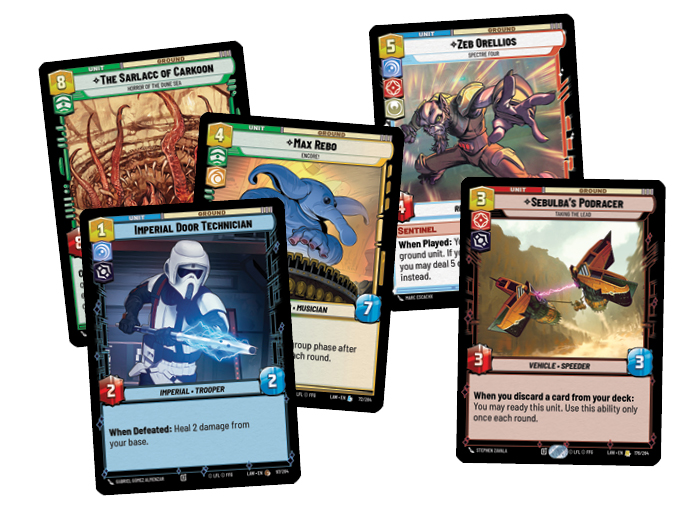
For its Star Wars: Unlimited TCG, Asmodee tailors its releases to bring younger players into the game.
Card games are a key focus for Asmodee, which manufactures Disney’s Star Wars: Unlimited and Marvel Champions TCGs. These games are regularly updated with new cards—after multiple rounds of design, playtesting and iteration to ensure that they’re accessible to younger players. The resulting features could include reducing the amount of text on a card, or simplifying the descriptions of the unique abilities each card confers.
“Designing for younger players is really about reducing friction by simplifying rules, minimizing text, and using clear visual cues so the game feels intuitive without constant explanation,” Sharp explains. “It is also important to streamline decision-making and create fast, rewarding gameplay loops that keep kids engaged from the start. Ultimately, the goal is to create an experience that is easy to learn, fun to play, and helps build confidence through clear, accessible design.”
Targeting kids can also include sponsoring local tournaments, which tend to draw younger players, and hosting in-store events tied to new releases as a way to draw kids back to traditional retail environments, she adds. “By creating engaging gameplay experiences and strong community environments, we’re able to welcome players of all ages who are excited to explore these worlds together.”
GETTING BACK IN THE GAME
The global TCG market is worth roughly US$8 billion a year, according to Mordor Intelligence and BCC Research. And Spin Master predicts that this will only grow as collecting, competitive play and fan communities take off—especially when it comes to the sometimes-overlooked kids demo. (The popularity of the category and the opportunity to reach younger consumers are driving the company to make its first return to trading card games since Bakugan.)
From a production standpoint, trading cards are one of the most accessible CP categories, since the cost of printing the cards is relatively low. The real investment is in game design, artwork, licensing and building a long-term content roadmap—all of which can take about a year to complete.
All told, Byrne estimates that getting into the trading card market could cost brand owners US$250,000 to US$500,000. But he puts this price tag into perspective by adding, “That’s significantly lower than introducing a new toy line that requires molds.”
If the goal is to build a community around a TCG, costs can be driven higher by engagement efforts such as live tournaments and online community management, says Angus Walker, Spin Master’s VP of marketing and global business unit lead for games.
However, one of the company’s TCG partnerships sidesteps much of that work. Spin Master has signed on as the North American distributor of the meme-inspired game Skifidol Italian Brainrot. Aimed at kids ages eight and up, its cards feature AI-created art depicting fanciful characters, such as a shoe-wearing shark or an assassin who’s also a coffee cup. This game is already a hot property, with several licensing deals and a popular Roblox game called Find the Skifidol Brainrot Card that has racked up 5.6 million visits.
To support bringing Skifidol Italian Brainrot to North America, Spin Master is pivoting towards localization and preparing the TCG for new markets, managing things like translation, packaging adaptation and drafting game rules that feel natural for English- speaking players.
“Fortunately, with a property like Brainrot, a lot of the humor and references are rooted in internet culture, which already travels well globally,” Walker notes. The IP’s comedic elements are also kid-friendly—rooted in memes, idiosyncratic jokes and language that are intrinsically connected to Gen Alpha.
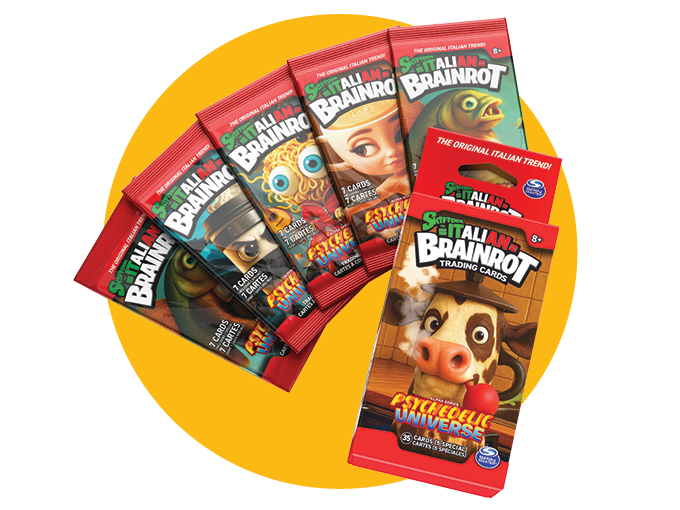
Spin Master’s Skifidol Italian Brainrot TCG leans into meme culture to connect with younger players.
“The team is excited about Brainrot as a trading card game because it taps directly into the internet culture that many younger fans already live in,” says Walker. “Turning that energy into a TCG creates a game world that feels immediately native to digital culture, rather than something that has to be explained. Brainrot characters, moments and humor translate well into shareable reveals, influencer play sessions and online community moments.”
Not content to have just one TCG in its portfolio, Spin Master is also collaborating with Universal Products & Experiences and the design team at Ghost Galaxy on a new entry called Hellbreak. This game features iconic monsters from Universal’s library, including Dracula and the Bride of Frankenstein.
Pulling characters, locations and gameplay mechanics from multiple franchises, the first release of 250 Hellbreak cards will be distributed in booster packs, sets and bundles.
While this game is intentionally designed to appeal to tweens and teens, it has the potential to attract both young players and their parents by featuring well-known characters and edging into the horror genre—filling a whitespace in the TCG market. Spin Master’s plan for the brand is to organize game competitions and grow a player base that spreads across multiple demos, says Walker.
This dual approach underscores a broader truth about the category: There’s no one-size-fits-all TCG strategy for the market. The audience you want to reach—ranging from more hardcore fans to casual enthusiasts who like collecting fun art—will determine what sort of game you make.
“Hellbreak and Brainrot are really two different ends of the spectrum when it comes to TCGs,” Walker adds. “Hellbreak is a ‘system’ that players and retailers will hopefully invest in deeply over time, whereas Brainrot is a much lighter game that’s rooted in expression based on topical internet trends. Both are important, but they each serve very different consumers looking for different types of experiences.”
PLAYING THE WINNING CARD
If there’s any lingering doubt about the strength of this category, a quick look at Wizards of the Coast should dispel it. WoTC and its Magic: The Gathering TCG propelled Hasbro’s digital gaming segment to record its strongest year ever in 2025, bringing in almost US$2.2 billion in full-year revenue and offsetting underperformance in other categories to help the company grow its overall revenue by US$1.4 billion (a 31% increase compared to 2024).
The enduring popularity of this 30-year-old TCG isn’t because of collectors, but rather because Magic: The Gathering has a large base of actual players that Hasbro is working to serve with new partnerships, community-building play opportunities and consumer products extensions, said president of toys, games, licensing and entertainment Tim Kilpin during his keynote at Kidscreen Summit in February.
One new strategy to help the game connect with kids is Universes Beyond—partnering with brand owners to make Magic: The Gathering cards featuring their IPs. Last year, the company introduced Universes Beyond sets for Spider-Man and Avatar: The Last Airbender, and more collabs are on the way for Teenage Mutant Ninja Turtles and Marvel’s superheroes.
Recognizing the potential for even more growth, Hasbro is expanding the Magic franchise into publishing, CP, digital games and even content. The toyco is in talks with Netflix and is also developing a live-action movie with Legendary Entertainment.
Hasbro is also reaping the rewards of using trading cards to refresh the 40-year-old My Little Pony (MLP) brand for a new generation of kids. A partnership with China-based Kayou resulted in 12 billion MLP cards sold domestically last year, Kilpin said. Next up, Kayou plans to launch these cards internationally.
“There’s an opportunity now for us to take Magic: The Gathering and apply [the] same kind of franchise playbook. There’s no limit to where this could go.”
The moment TCGs are currently having with kids is a big draw for retailers. In particular, trading cards are a strong category for Walmart Canada, with brands like Pokémon, One Piece, Yu-Gi-Oh! and Magic: The Gathering topping the list as customer favorites. And now the retailer is looking for other opportunities to expand its TCG business and keep up with growing demand across multiple demos, says Daniel Laviola, Walmart Canada’s merchant for action fi gures and trading cards.
“Trading cards continue to be a winning hand for us,” says Laviola. “In a time when value matters, trading cards deliver. It’s an accessible hobby—you don’t have to spend a lot to get started, but the experience feels big. A pack of cards can spark hours of entertainment, whether kids are learning the game or parents are sharing something they loved growing up.”
Pokémon, which has been publishing cards since 1996, is a great example of how TCGs can be core to a brand. When trading cards are in the mix, kids don’t need to have the latest video game, pricey toys or even apparel to be a part of the fandom, says Byrne. “If you’ve got a pack of cards, you’re in the realm.”




















 Newsletter